Start with your electrical panel, not the charger. A licensed electrician’s load calculation shows whether your home can carry a new 240-volt circuit, and that answer shapes much of what follows: the permit, the charger you can run, and whether the job lands near $1,000 or closer to $5,000.
One more thing to budget around: the federal home charger credit ended on June 30, 2026, so treat any local rebate as a bonus rather than a plan.
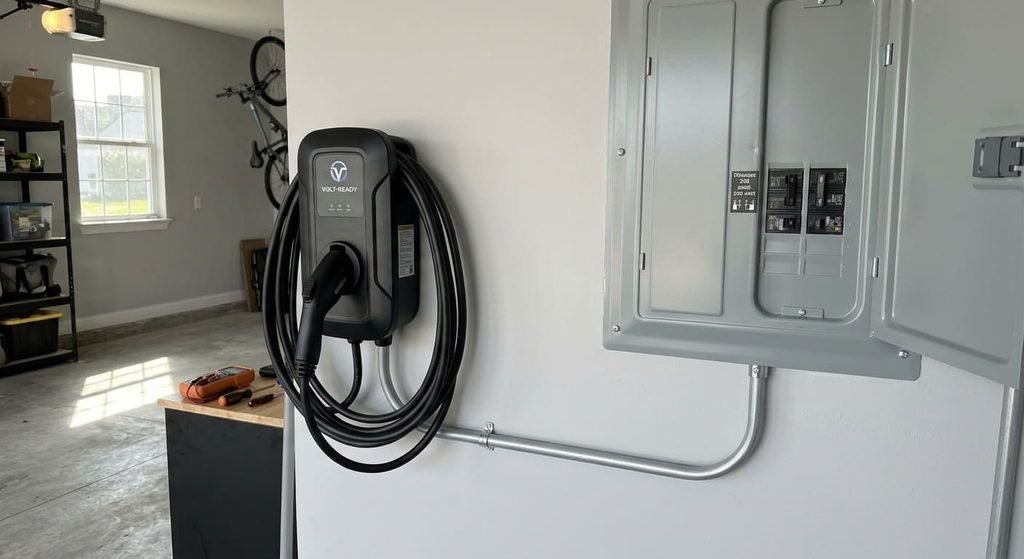
Do you need Level 2 at all?
Maybe not because the Department of Energy puts Level 2 at roughly 25 miles of range per hour, and the 2021 National Household Travel Survey puts average daily driving at 19.9 miles (DOE). Do the math and an average day needs under an hour of Level 2. A regular wall outlet (Level 1) adds around 5 miles per hour (NRG, citing DOE), which works out to about four hours for that same day.
If you park overnight and drive modestly, Level 1 may cover you. If you drive further, or want room to spare, Level 2 tends to be the practical choice. Either way, you are probably planning around home charging: AAA, citing DOE, says more than 80% of EV charging happens at an owner’s residence (AAA).
Step 1: Have the panel checked
Before you buy anything, ask an electrician for a load calculation. Code treats EV charging as a continuous load, so the circuit is sized at 125% of the charger’s output. That is why a 48-amp charger calls for a 60-amp breaker (Portlandia Electric Supply). It also needs its own dedicated circuit, which some cities spell out in their permit checklists (City of Elk Grove). One guide notes that a full 100-amp panel rarely has room for a 40 or 50-amp charger, even when slots are open (Portlandia).
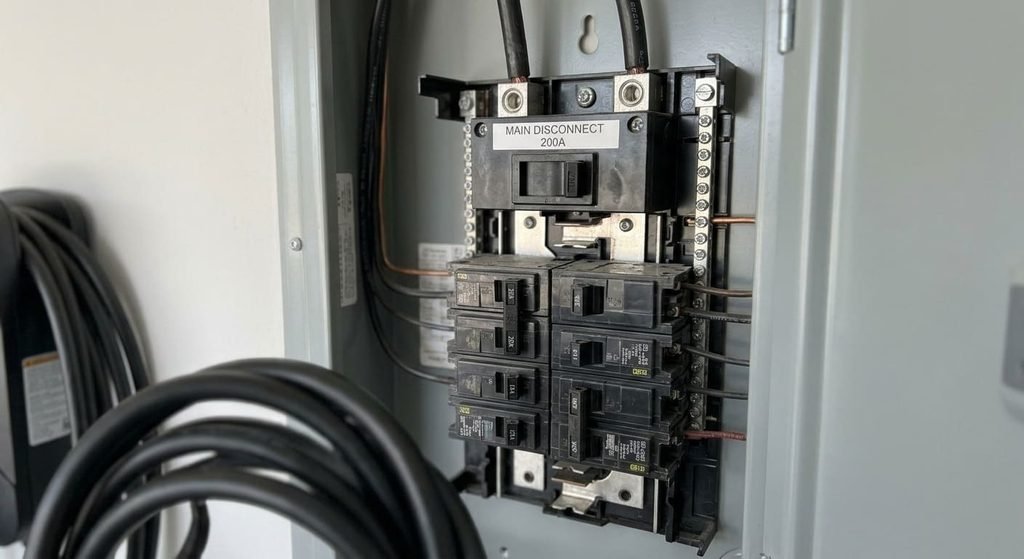
If the panel fails the test, you generally have two routes:
- Upgrade the panel. One installer says this adds $1,500 to $4,000 (Always Do Better).
- Add load management. These devices slow or pause charging when the whole house nears its limit. SMUD describes units that cut power to the charger at 80% of panel capacity (SMUD), and a Pennsylvania guide prices them at $300 to $500 (ONREC). Emporia says its version meets the energy management rules in the code (Emporia).
Ask your electrician to price both, and confirm your local building department accepts the load management route.
Step 2: Choose plug-in or hardwired
A NEMA 14-50 outlet is the plug-in route, and code caps it at 40 amps of continuous charging (AJ Long Electric). Outdoor outlets also need a weatherproof cover and a GFCI breaker (Eviqo). Hardwiring lets a charger like the Tesla Wall Connector run 48 amps on a 60-amp circuit (Tesla Motors Club). The trade-off is portability, since a plug-in unit can come with you if you move.
Owners on the Rivian forum show both sides: one replaced a melted 14-50 outlet with a hardwired charger, while others say a high-grade outlet works fine if you go plug-in (Rivian Forums).
[EMBED 1 HERE: the Rivian Forums post above, or a Reddit/X post on plug-in versus hardwired. Credit the author and link to the thread.]
Step 3: Pull the permit
Level 2 installs usually need an electrical permit and an inspection, though rules vary by city. Sacramento County requires a permit for Level 2 and asks for a load calculation when the service panel is 125 amps or smaller (Sacramento County). Elk Grove wants the contractor’s license number, a panel schedule, the load calculation, and the charger specs (Elk Grove).
Call your building department and ask for its residential EV checklist before work starts. Some installers handle the paperwork, so confirm it is written into the quote.
Step 4: Renting or in a condo? Check your state
Right-to-charge laws exist so associations and landlords cannot unreasonably block a charger at your assigned space. One tracker counted 15 states plus DC as of May 2026, and only some extended protection to renters (Dashboard Symbols). Details differ a lot:
- Maryland: owners can install in a deeded or assigned space, associations can set reasonable requirements, and the owner pays. There is also a 60-day approval rule and changes that took effect October 1, 2026 (FirstService Residential).
- Illinois: the law applies only to associations established after it took effect (KSN Law).
- California: Civil Code 4745 covers owners and renters in condos and planned communities (Greenlancer).
Look up your own state in the DOE Alternative Fuels Data Center laws database, then send your board or landlord a written request that names a licensed, insured contractor.
Step 5: Compare quotes, then check rebates
Get at least two itemized quotes, and ask each one whether it covers the load calculation, permit fees, wire run length, and any panel work. A straightforward install can take around 2 to 4 hours of electrician time, according to one installer (Always Do Better). The calendar usually stretches because of approvals, like Maryland’s 60-day HOA window.
Read rebate rules before you buy the charger. One aggregator reports state and utility rebates of $200 to $2,500 (Eviqo). PECO offers up to $500 for a networked charger enrolled in managed charging (ONREC), while one California source found no active SDG&E residential rebate (NRG). Programs may require a specific smart charger or proof that you own an EV (Volted).
On the federal side, Section 30C covered 30% of a home charger up to $1,000, but only for equipment in service by June 30, 2026 (Rewiring America; Dow Jones).
What it costs
| Item | Typical range | Source |
| Charger unit | $300 to $800 | Sunrun, Always Do Better |
| Standard install, panel has room | $800 to $2,500 all-in | Sunrun, Eviqo |
| Panel upgrade, added on top | $1,500 to $4,000 | Always Do Better |
| Full project with panel upgrade | about $2,500 to $5,000+ (California: $4,500 to $7,500) | ONREC, NRG |
| Load management instead of upgrade | $300 to $500 | ONREC |
Most published figures come from installers and charger sellers, so use them as ranges and compare against local quotes. Wire distance, panel condition, and ZIP code can all move the total.
How long until it pays off?
Here is the math we ran, using public inputs. Swap in your own mileage.
- Driving: 12,000 miles a year at 30 kWh per 100 miles (an illustrative efficiency from NRG), or 3,600 kWh.
- Home power: 18.83 cents per kWh, the April 2026 national residential average per EIA data cited by NRG. That comes to about $678 a year.
- Public charging: AAA’s blended average was about 37 cents per kWh in October 2025 (EnergySage), roughly $1,332 a year. DC fast charging averaged about 49 cents per kWh in late 2025 per Recharged, roughly $1,764 a year.
- Gasoline: the BTS reports $4.36 a gallon for September 2026, up 37.6% from a year earlier (BTS). A 30 mpg car at that price costs about $1,744 a year, so charging at home may save roughly $1,000 a year against gas.
The charger itself only pays off by replacing more expensive charging, so the useful question is how long the install takes to earn back its cost against public charging:
| Install cost | Versus public blended (saves about $654/yr) | Versus DC fast (saves about $1,086/yr) |
| $1,500 | about 2.3 years | about 1.4 years |
| $2,500 | about 3.8 years | about 2.3 years |
| $5,000 | about 7.6 years | about 4.6 years |
Two caveats. If Level 1 covers your driving, a Level 2 install may never pay back in fuel money, and its value is mostly speed and convenience. And where power is pricey, the gap narrows: New York’s residential average hit 29.45 cents per kWh in April 2026 (Empire Center). EIA expects residential prices to keep rising in 2026 (EIA).
What homeowners say
We only picked voices that point in the same direction as the steps above.
- Permits. A Mach-E Forum member argued that skipping the permit can cause trouble with insurers, HOAs, and a future home sale, and suggested checking with your city before installing a Level 2 charger (Mach-E Forum).
- Panel and outlet checks. A homeowner on Volted said an upgrade may be needed, so they added a subpanel during the install, and learned a GFCI breaker is required for an EV outlet (Volted). A HomeAdvisor reviewer said the electrician showed them why their old outlet was not suited to continuous charging (HomeAdvisor).
- Itemized quotes. Another HomeAdvisor reviewer said the lack of an itemized receipt made the price hard to understand (HomeAdvisor).
- Rebate fine print. In Reddit comments compiled by GummySearch, one owner bought a ChargePoint unit because their utility required it for the discounted overnight rate (GummySearch).
- Condo owners. A Virginia condo owner had the state’s right-to-charge law on his side and still had to convince his board the project was safe and doable (Canary Media).
EVs Future is a team of researchers that answers questions about EVs, so you can make better decisions with real data behind them.
Have a charging question we have not covered? Tell us and we will dig into it.