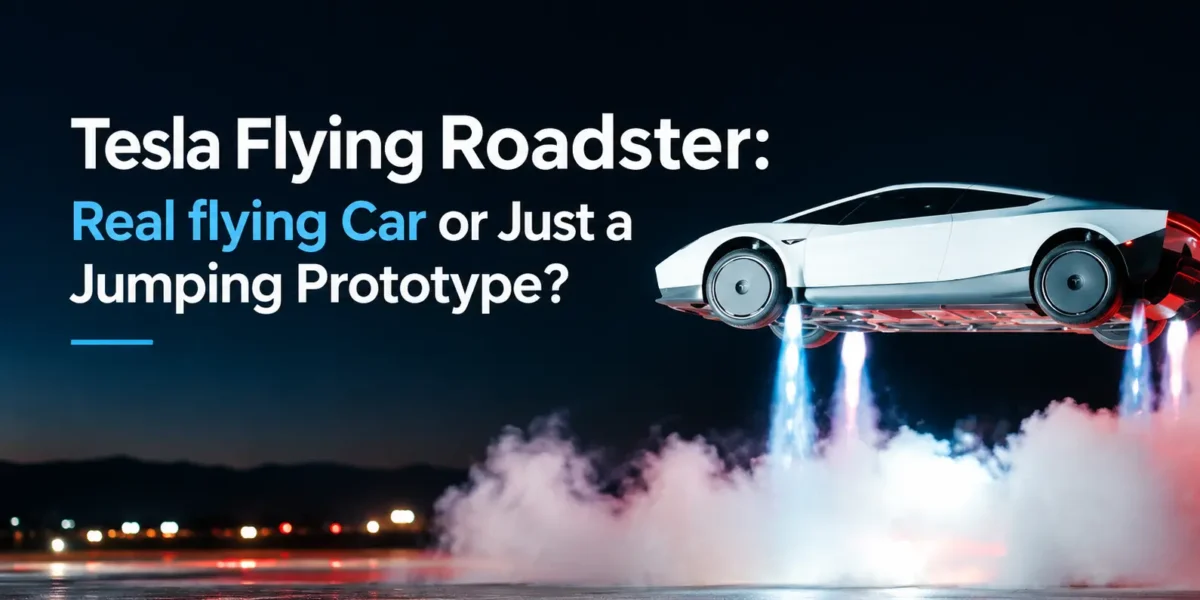
On October 15, 2026, Tesla’s new Roadster drove up an inverted ramp at a SpaceX test site in Texas, left the ground, flipped, and landed on its wheels. Elon Musk called it a flying car. What the cameras showed was a jump, and our view is that even if every claim Tesla makes turns out to be true, this car may not become a usable road vehicle in the USA or any other developed country for 25 years or more.
To keep this fair, we are going to give Tesla the benefit of the doubt on everything. Let’s assume the thrusters work, the production date holds, and the prototype becomes a real machine. The question we want to answer is a simple one: would it be useful on a real road? The rest of this post covers the reasons we say no, starting with the smog, mist and dust that come with it.
What Tesla Showed on Stage
The flying version is called the Roadster Rocket. It uses ten cold-gas thrusters built with SpaceX, fed by compressed air stored in tanks inside the car. Reports from the event put the stored air at around 600 liters, which is roughly 250 kilograms. The car climbed the ramp, launched, flipped, hopped over other Teslas and came down on its wheels.
A few details matter more than the flip itself. The demo car had nobody inside. Musk himself said it is not necessarily a safety-optimized car, and Tesla’s website says the flying version is not approved for public roads. CBS News reported that a non-flying Roadster can be reserved with a $5,000 deposit, while the Rocket version with the full flight system is planned as invitation only. CNBC reported that production is targeted for 2028 with no price announced, and Tesla has missed every delivery date it has set for this car since 2017.
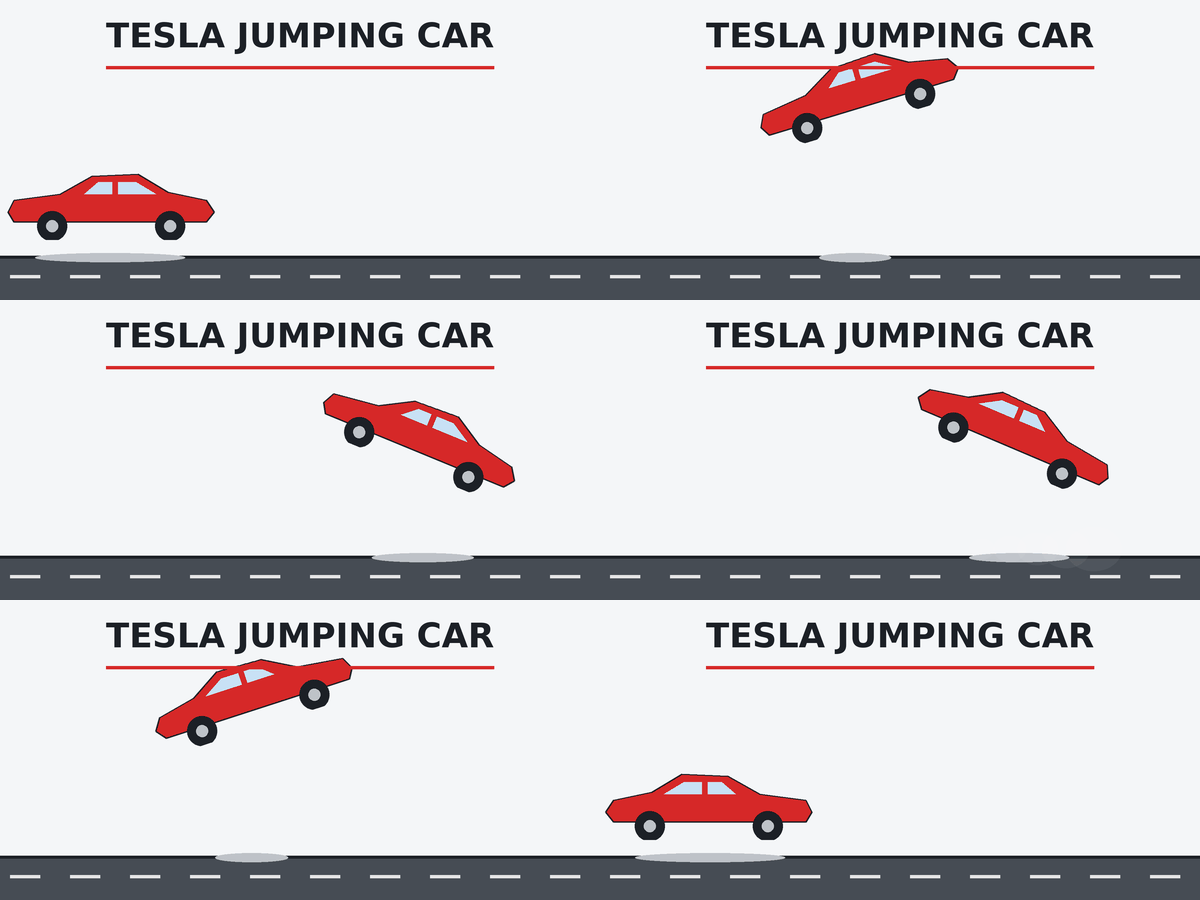
Why We Call It a Jumping Car
We are not sure the word flying fits, so in this post we will say jumping car. A compressed-air thruster is built for a short, hard push. It has no wings, no rotors and no way to keep pushing once the tank pressure drops.
Here is some basic physics, and these are our own rough estimates since Tesla has not published the numbers. Say the car weighs about two tons. To hold it in the air you need around 19.6 kilonewtons of upward force. Compressed air thrusters generally get a specific impulse of about 50 to 60 seconds, which means the air leaves the nozzles at roughly 500 to 600 meters per second, more than 1,000 miles per hour. At that rate the car would burn through something like 33 to 40 kilograms of air every second. With 250 kilograms on board, that gives six to eight seconds of hovering, and that is before any air is spent on lifting off, flipping or landing.
The CEO of Rimac, a company that builds electric hypercars, described the same trade-off in an earlier interview about Roadster thrusters. He said the air is gone in two to three seconds, and then you are carrying tanks, compressors, valves and nozzles as dead weight. So what we are looking at is a hop, and a well-controlled one.
What Comes Out of the Nozzles
First, a clarification on the word smog. These thrusters run on compressed air, so nothing is burning and there is no black exhaust like a rocket or a jet engine would make. Still, a jet of air leaving at that speed does not stay invisible.
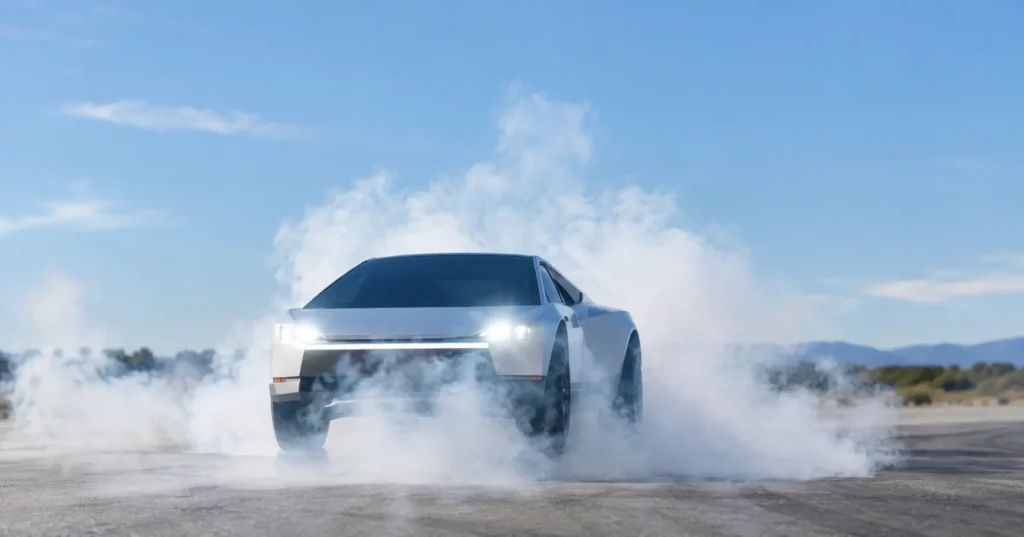
When compressed air expands to normal pressure, it cools sharply. You can see the same thing when a scuba tank valve is cracked open on a humid day and a white mist forms. Moisture in the surrounding air may condense when it meets that cold jet, so a car with ten nozzles around and under it could wrap itself in a cloud within a second or two. How thick that cloud gets depends on the weather. It may be heavy on the Gulf Coast in summer and much lighter in the dry Southwest.
Then there is dust. A jet pointed at the ground at that speed lifts whatever is lying there: dirt, sand, gravel, trash, water on the pavement. A test ramp is clean, but a real street is not. Loose gravel thrown sideways can chip windshields on nearby cars and hit people on the sidewalk. And it will not be quiet. Musk himself said in a 2025 interview that flying cars would be quite noisy, which is a fair point to bring back to his own car.
Can the Driver See Anything?
In the daytime, sunlight scatters off mist and dust, so the cloud tends to glow white, and when the driver is facing the sun it may look like a wall. The cloud also hangs around for a moment after the thrust stops. That matters because landing is the part of the jump that needs the clearest view, and it happens right when the view is at its worst.
At night, headlights hit the worst, mist and dust and throw light straight back into the driver’s eyes, a bit like high beams in heavy fog. Contrast drops, streetlights smear, and brake lights from other cars become hard to read. The drivers around the Roadster would be hit by the glare too.
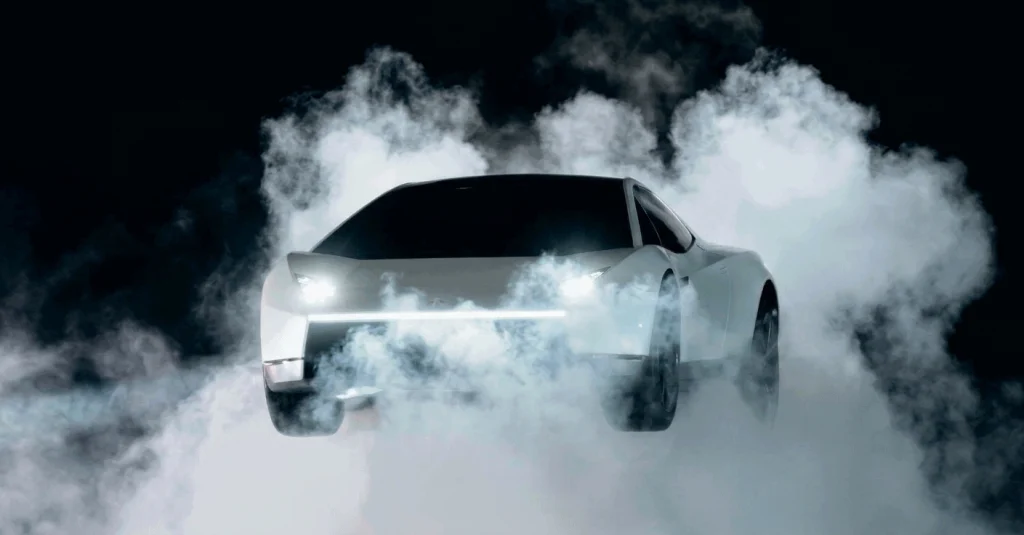
The seating position makes it worse. A Roadster sits low, with the driver only a few feet above the road and the nozzles spread around the cabin, so the person inside is sitting in the middle of the cloud. As far as public reports show, nobody has tested what a human actually sees during one of these jumps, because nobody was in the car.
Who Would Be Flying It?
So let’s assume Tesla fixes the visibility problem by removing the human from the jump completely. Cameras and software handle the whole thing, and the driver is a passenger for those few seconds. The demo car was run that way, with nobody on board.
That creates a different problem. A flying car is supposed to be something a normal person can use, not a pilot. If the jump needs a computer, then the buyer is not flying and not really driving. FLYING magazine, as summarized in a recap of the event, pointed out that owners would probably need some form of pilot certification and that Tesla would need FAA authorization on top of meeting federal motor vehicle standards.
The rules are not clear either. The FAA told CBS News that the Tesla vehicle does not meet its definition of an aircraft. The National Highway Traffic Safety Administration said that the car may appear to defy physics but still has to meet federal motor vehicle safety standards. A senior Department of Transportation official admitted to CBS that there is no clear answer on who would decide whether a car like this is safe. A vehicle that no agency clearly owns is a hard thing to put on a public road.
It Is a Sports Car First
This point gets lost in the excitement. The Roadster is a two-seat sports car, not a family car and not a commuter. Reports from the event say certain versions are claimed to reach 60 mph in under a second and top 230 mph. Musk has said before that if safety is your number one goal, you should not buy the Roadster, and he compared it to buying a Ferrari.
A car like that often needs a skilled driver on a good day. Now add tanks, compressors and valves that make the car heavier, and a jump function that has to be triggered at the right place on a road full of other traffic. The group Advocates for Highway and Auto Safety has already raised concerns about the 230 mph top speed alone, as Politico reported, noting that speeding remains one of the leading factors in US crashes. A price has not been announced, and the last number Tesla quoted for the base car, years ago, was $200,000. Taken together, this looks like a small-volume toy for a track or private land, and a very different thing from a car for everyday roads.
The Car That Tried It First
Most people reading about the Roadster have probably never heard of the Alef Model A.
It is an electric sports car that drives on the road, then stops and lifts off vertically like a drone, with the body turning 90 degrees in the air to move forward. Alef unveiled it in 2022 and received a Special Airworthiness Certificate from the FAA in 2023, which was described as the first time a vehicle of this kind got legal approval to fly in the US.
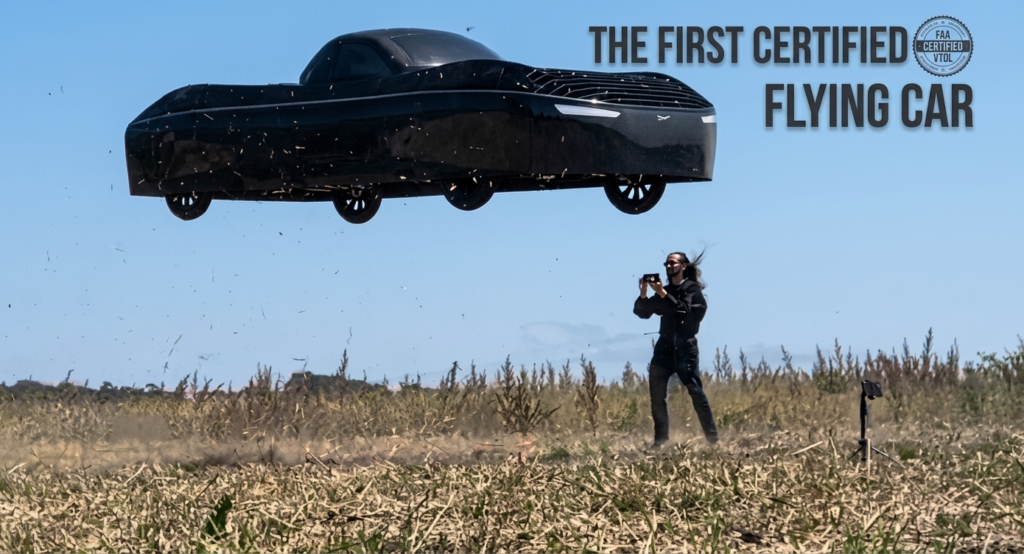
Even that certificate came with limits. The FAA said it was issued for purposes such as exhibition and research, and ABC7 reported that the company planned to certify the road version as a low-speed vehicle, which generally means about 25 mph on pavement. Compared with the Roadster, the Alef got very little public attention, and our guess is that it comes down to publicity. Tesla has a huge audience and Musk knows how to use it, so the same idea gets a global audience when his name is on it.
What People Are Saying Online
The reaction has been split. Fans filled social media with excitement within hours, and jokes about flipping over traffic spread almost as quickly. On the other side, readers under the Autopian’s piece on the Roadster called it a stunt meant to lift the stock price. One commenter claimed the car used in the show was a stripped-down shell. That is only a comment and nobody has proven it, but it shows how much doubt is out there.
The press has been careful as well. Space.com said it is hard to imagine regulators certifying the flying version for everyday use.
CNBC wrote that the Roadster is unlikely to have a material financial impact on Tesla, and Bloomberg’s coverage framed the demo as a way to pump up a sluggish auto business. The doubts we raised in this post are the same ones showing up in a lot of the comments.
If We Remove the Gas and Keep Only the Jump
Here is a short note to close the technical part. Imagine engineers solve everything we described. No mist, no dust, no glare, and only the jump function stays. Even then, a jump does not make this a car you can drive on a normal road, and it does not make it a flying car either. The road still sets the limit, with its traffic, pedestrians, wires, trees and rules.
Where it may become practical is a simpler version. If the jump is a basic driver-controlled function, something like a sport mode button with no AI or machine running the show, and nobody calls it flying, it could find a home on a closed track, a private property or a stunt show. For that use it would be a very expensive sports car with a party trick. Calling it a flying car is what sets expectations the technology is unlikely to meet.
Our Take
The Tesla Roadster is a real sports car with a real jump, and the October 15 demo was impressive to watch. Based on what we found, though, it looks more like a prototype built to win attention than a machine ready for real roads in the USA or any other developed country. The smog and dust, the poor visibility, the problem of who controls it, the sports car limits and the missing rules all point in the same direction.
This article is based on research and our own estimates, and it is not a recommendation to buy or avoid any vehicle. EVs-Future shared it as help and ideas so you can make better decisions, and we will update it as Tesla releases real specs and rules.