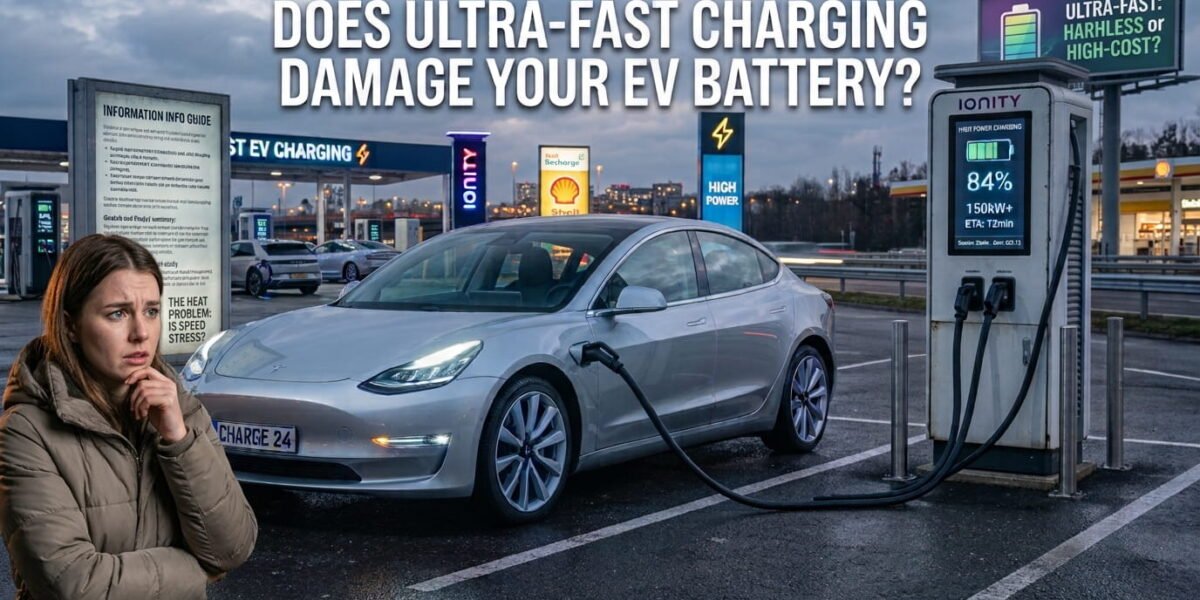
The answer is yes, but much less than most people fear, and it depends on how often you do it.
- Occasional fast charging (road trips, emergencies): no measurable harm in real-world data.
- Daily high-power fast charging (100 kW and above): your battery loses capacity roughly twice as fast as with slow charging. That is a real cost, but not a ruined battery.
- Megawatt-class “flash” charging (BYD’s 1,000-volt system and similar): too new to judge. The only long-term evidence so far comes from the manufacturer. It is also not available to US drivers yet.
The rest of this guide shows the evidence behind each of these three points, what real owners say, and how to charge so you get the speed without the wear.
Why people worry: the heat problem
Every battery gets warm when you push energy into it quickly. Heat and high current speed up the chemical wear inside the cells.
Example: Think of filling a water bottle. A slow tap fills it gently. A fire hose fills it in seconds, but the water splashes, pressure builds up, and the bottle takes more stress. A battery is similar. The faster the energy goes in, the more heat is produced and the more stress the cells take.
The physics is simple. Heat from electrical resistance grows with the square of the current. This is why BYD moved to 1,000 volts. At 1 megawatt, a 1,000-volt system needs about 1,000 amps, while a typical 400-volt car would need about 2,500 amps. With everything else equal, 2.5 times the current means roughly six times the resistive heat. Higher voltage is a clever way to cut that heat, but it does not remove it.
That is the theory. What matters is what happens to real cars over many years.
What the big data says
Geotab: 22,700 EVs, 21 models
The largest real-world study comes from fleet-data company Geotab, which tracked battery health on more than 22,700 EVs across 21 models.
- The average battery loses about 2.3% of its capacity per year, which projects to about 82% health after eight years.
- Cars that used DC fast charging above 100 kW most of the time lost about 3.0% per year. Cars that mostly charged on AC or at lower power lost about 1.5% per year.
- Charging power was the strongest operating factor in the study. Climate mattered less, adding roughly 0.4% per year in hot regions.
- Degradation sped up mainly when cars spent most of their time (over 80%) at very high or very low charge levels.
What this means in miles: take an EV that starts with 300 miles of range. After eight years:
- Mostly slow charging (1.5% per year): about 88% health, so roughly 264 miles.
- Heavy high-power fast charging (3.0% per year): about 76% health, so roughly 228 miles.
The gap is about 36 miles. It is a real difference, and you would notice it on long trips. But the heavy fast-charging car is still far from “dead”, and it stays above the roughly 70% level that many battery warranties use. Check your own warranty terms, because they vary by maker.
Recurrent: 12,500 Teslas
A different study by Recurrent looked only at Teslas. It compared cars that fast charged more than 90% of the time with cars that fast charged less than 10% of the time. It found no statistically significant difference in range loss between the two groups.
Why the two studies seem to disagree
They do not really conflict. They measure different things:
- Geotab covers many brands, including some with simpler cooling systems. Recurrent covers one brand known for strong battery thermal management.
- Recurrent’s study is from 2023. Charging speeds have risen since then, and Geotab’s newer data captures that.
- Recurrent itself warned that fast charging can cause harm in extreme heat, in extreme cold without preconditioning, and at very low or very high charge levels.
Tesla’s owner manual also admits that after many DC fast-charging sessions, the peak charging speed may drop slightly. So even the most favorable data shows a small effect over time. The sensible reading is that a good battery management system softens the damage, but does not erase it.
What real owners say online
Studies give averages. Owner forums show how those averages feel in daily life. We looked at Reddit, Tesla Motors Club, the Lucid Owners forum, InsideEVs forum, and a Lemmy discussion about BYD. We were not able to pull reliable posts from X (Twitter) for this guide, so we leave X out rather than guess. We summarize the discussions in our own words and treat them as anecdotes, not proof.
“Fast charging barely matters.”
- In a Reddit thread discussing the Geotab study (over 300 upvotes), one commenter who said they used to work at Rivian said loaner cars were regularly charged to 100% and showed no range loss after years of use. They also noted that many customers set low charge limits “just in case”.
- On Tesla Motors Club, one member said a used Model S they sold had been Supercharged almost daily and still reached about 280,000 miles on its original battery.
- A Lucid owner reported two years of mostly DC fast charging to 75-80% and estimated only about 4% battery loss.
- On the InsideEVs forum, a buyer said a used Nissan Leaf with 100,000 km that had been fast charged almost its whole life had battery health similar to Leafs that were never fast charged.
“It adds up if you do it every day.”
- Several owners on the Lucid forum, including one sharing advice from a battery engineer, recommend slow charging for daily use. They also suggest preconditioning before DC fast charging and not leaving the car at 100% for long periods.
- A Tesla Motors Club member asked for real data in a thread about daily Supercharging. Another replied that most of what is online is just opinion. This is a good summary of the whole debate.
- Reports from Chinese owners point the other way for ultra-fast charging. One commuter who relied on a lunchtime supercharger every day found his battery health below 90%. Industry articles claim cars that use ultra-fast charging for most of their charging can drop to about 85% health within two years. These claims are not peer reviewed, and they mix different cars and conditions, so treat them as a warning sign rather than a fact.
“Can we trust BYD’s flash charging?”
- On a Lemmy discussion about BYD’s megawatt charging, skeptics said faster charging means more heat and more wear, and asked why BYD does not publish full long-term results. Supporters answered that the 1,000-volt design lowers heat and that BYD cells are rated for thousands of cycles.
The pattern across these communities is consistent. People with moderate fast-charging habits report few problems. People who fast charge daily, especially at the extremes of charge level, report more wear. Nobody seriously says one fast charge will hurt your battery.
The ultra-fast question: 10 minutes, 1,000 volts
This is the part most readers are asking about, so we separate claims from evidence.
What BYD says. BYD’s second-generation Blade Battery and flash-charging system can charge from 10% to 97% in about nine minutes at up to 1,500 kW. After a blogger’s test showed cell temperatures reaching about 70°C, BYD’s battery chief technology officer said the company ran long-term testing, including 1,000 full flash-charging cycles, before putting the technology into cars.
What a reviewer saw. A European test car reportedly covered 30,000 km with 350 flash-charging stops in nine days, drawing up to 640 kW. BYD says it still had 98.7% of its battery capacity. This is encouraging, since early-life degradation is usually the fastest, but it was a short test.
What is missing. One technical review pointed out that the cold-weather demonstrations were organized by BYD itself, and that no independent body has yet measured real-world degradation after hundreds of flash-charging cycles.
What it means for US drivers. ChargePoint announced plans for 600 kW chargers in the US in 2026, which would allow roughly 10-minute charging. But at the time of that report, no EV on sale in America could accept that much power. Today, most US drivers will meet 150-350 kW chargers, which is the range Geotab’s data actually covers.
Example: Imagine buying a new car whose maker says its battery can be fast charged hundreds of times with no loss. It might be true, and the early tests look promising. But the maker is also the one selling the car. Until independent owners drive these cars for several years, the honest status is “promising, not proven”.
Putting it together: three drivers, three outcomes
These are illustrative examples, not real people.
The road-tripper. She charges at home on a Level 2 charger and fast charges maybe once a month on trips. Her fast-charging share is well below 12% of sessions, which is the group in Geotab’s data that lost about 1.5% per year. Verdict: no reason to worry.
The apartment commuter. He has no home charger and fast charges at a public station three or four times a week, often at 150 kW or more. He sits in the higher-wear group. Expect closer to 2.5-3.0% per year, so about 76-80% health after eight years. Verdict: acceptable, but he can reduce the wear by choosing slower chargers (50-100 kW) when he is not in a hurry, and by stopping at 80%.
The early flash-charging adopter. She drives a 1,000-volt car in a market that has megawatt chargers and uses them daily. Her car’s cooling and design are built for it, and early tests look good. Verdict: probably fine, but nobody has the five-year data yet.
The lesson is that three factors decide the outcome: how powerful the charge is, how often you do it, and the conditions (temperature and charge level).
How to fast charge without paying for it
- Use slow charging for daily needs. Keep fast charging for trips and time-critical stops.
- Precondition the battery. On many cars, setting the charger in the navigation warms the battery first. This matters most in cold weather.
- Avoid fast charging at the extremes. Charging from very low levels up to about 80% is the fastest and gentlest zone. Most cars slow down above 80% anyway, so stopping there saves time and wear.
- Be careful in extreme heat. A battery that is already hot from a summer highway drive takes more stress at an ultra-fast charger.
- Do not store the car at 100%. Charge to full only when you need the range for a trip.
- Match the charger to the need. If you will be inside for an hour, you do not need the fastest charger available.
- Check the warranty and battery health. Know your warranty terms and use your car’s battery-health readout when it is available.
The clear answer
Ultra-fast charging does speed up battery wear, but the effect is gradual, predictable, and moderate.
- One fast charge: harmless.
- Occasional fast charging: no measurable effect in the best-quality data.
- Daily high-power fast charging: roughly double the yearly capacity loss (3.0% vs 1.5% per year in Geotab’s data), which still leaves most batteries around 76% after eight years.
- Megawatt flash charging: promising manufacturer tests, but no independent long-term proof yet, and not available to US drivers today.
The best habit is simple: slow charging for daily life, fast charging for the journey. If you follow that, you get nearly all the convenience with very little of the cost.