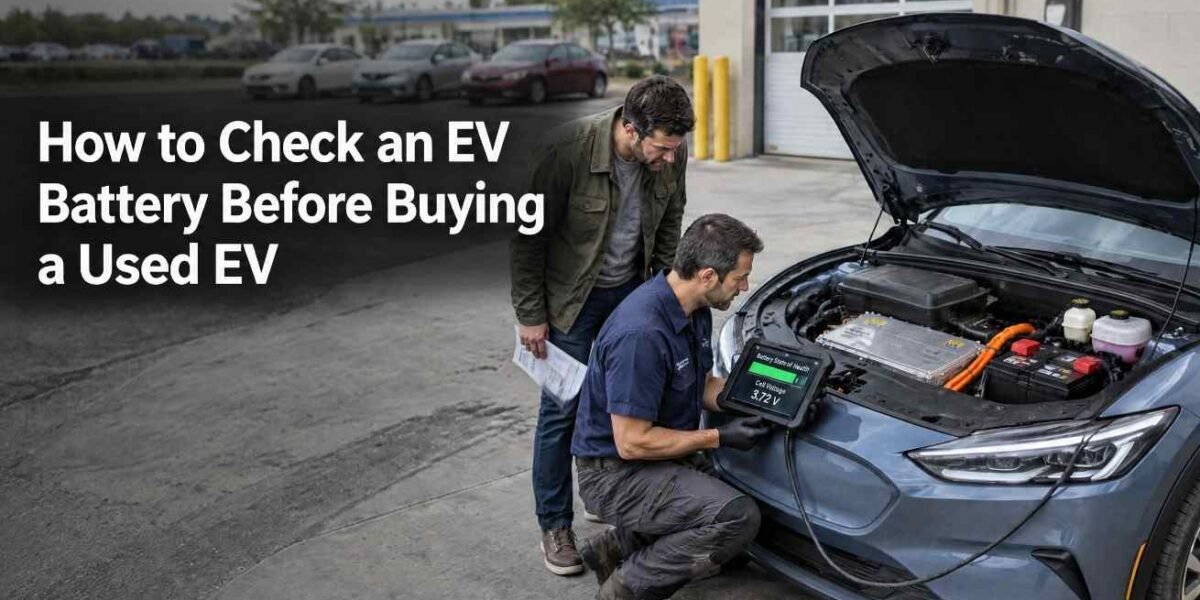
Our research team compared fleet data, expert guidance and real owner reports to show you what to check, in what order, and what the results may mean for your price.
Ask for a dated battery health report, confirm the remaining warranty by VIN, then cross-check with a full-charge range test. If the price is high, add a $20 to $50 scan or a pro inspection. No single number settles it, but two or three checks that agree tend to get close.
A battery that looks fine on the dash can still hide a problem. Consider a Canadian buyer who picked up a used 2013 Leaf out of a wish to drive more sustainably. Three years later the car could not reach its original range, and he struggled to get a replacement pack. A U.S. owner on KBB bought a 2017 Leaf SV at 40,000 miles and said it served him perfectly well. Same model family, two very different outcomes. Age, cooling design, climate, charging habits and warranty explain most of the gap, and that is what this guide helps you check.
How did we put this guide together?
We are a research team. We don’t sell cars or inspections, and we haven’t tested these vehicles ourselves. At Evs-Future, we compared fleet data from Geotab, dealer and retailer guides, AAA’s expert Q&A, consumer reviews and owner reports. We then noted where they agree and where they split.
Those are our judgment calls built on the numbers, and you are free to disagree.
What are we actually measuring?
Most of the confusion comes from vocabulary, so here are the terms with an everyday comparison for each.
| Term | Plain meaning | Everyday comparison |
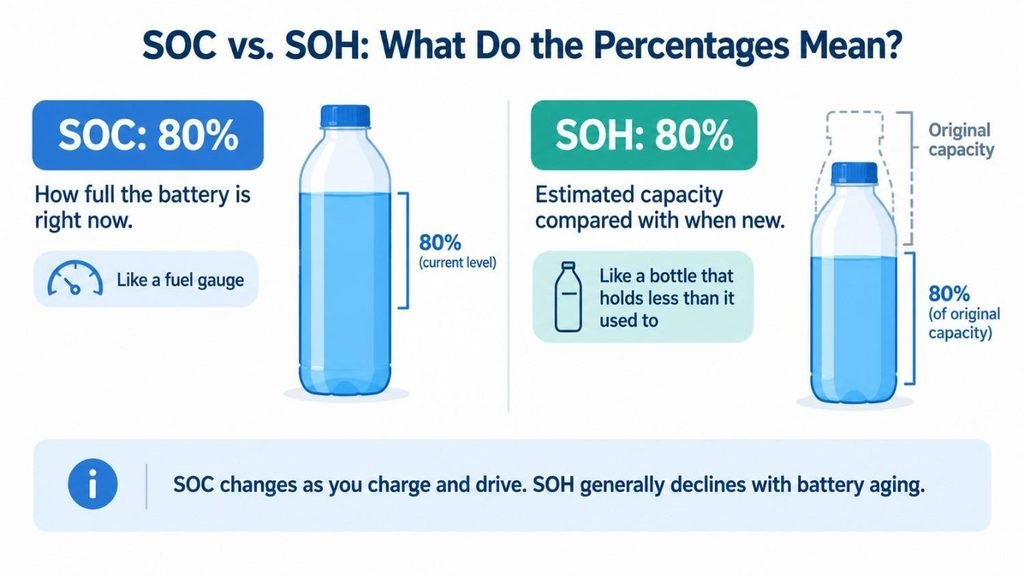
| State of health (SOH) | How much capacity the battery holds now versus new | A water bottle that has slowly shrunk |
| State of charge (SOC) | How full the battery is right now | The fuel gauge |
| Degradation | Capacity lost with age and use | A phone that lasts less each year |
| kWh | The size of the battery | Gallons in the tank |
| Battery management system (BMS) | The car’s computer that tracks the cells | A bookkeeper keeping a ledger |
| Cell imbalance | Some cells charge or drain differently from others | A flashlight with one weak battery |
| DC fast charging | High-power charging at public stations | Filling a bucket with a fire hose |
| Level 2 charging | Slower 240-volt home-style charging | The garden hose |
| Thermal management | Heating and cooling of the pack | A radiator for the battery |
SOH is an estimate. One guide calls it not a universally standardized reading. A fleet expert warned that there is no agreed method across brands, and some overstate the starting point. Treat any single SOH figure as a good clue, not a verdict.
How much battery loss is normal?
Geotab’s 2025 analysis of more than 22,700 EVs across 21 models found an average loss of 2.3% per year. Charging style mattered more than most people expect:
- Mostly lower-power charging: about 1.5% per year.
- Frequent high-power fast charging above 100 kW: up to 3.0% per year.
- Hot climates: roughly 0.4% extra per year.
- After the early years, many models settle near 1.4% per year.
Here is our own simple arithmetic from those rates, with straight-line math that will run slightly pessimistic for older cars:
| Car age | Gentle use (1.5%/yr) | Average (2.3%/yr) | Heavy fast charging (3.0%/yr) |
| 2 years | about 97% | about 95% | about 94% |
| 4 years | about 94% | about 91% | about 88% |
| 6 years | about 91% | about 86% | about 82% |
| 8 years | about 88% | about 82% | about 76% |
Other guides land in the same neighborhood. One suggests 85 to 95% is normal on a 3 to 6 year old EV, and another expects 90 to 95% at 3 to 4 years.
Our read: Geotab’s data comes from telematics-equipped vehicles, many of them fleet cars, so a private car may do better or worse. We would use the middle column as the starting point. A reading five or more points under it deserves a question to the seller. One other thing: the same Geotab work suggests you needn’t worry much about previous owners charging to 100%, since wear mostly accelerates when a car sits near full for most of its life.
Which checks can you do, and how far should you trust each?
| Check | Typical cost | Time | What it tells you | Weak spot |
| VIN-based report (such as Recurrent) | Often free on dealer listings | Minutes | Expected range and how the car compares with similar ones | An estimate from charging data, not a direct cell measurement |
| Seller’s app or dash readout | Free | Minutes | Capacity or max range at full charge | Methods differ by brand |
| Full-charge range check | Free | 15 minutes | Rough SOH | Weather and driving style move it |
| OBD2 dongle plus app | $20 to $50 | 10 minutes | BMS data such as SOH and cell voltages | Needs a model-specific app |
| Purpose-built test kit with a shareable certificate (shown in the video below) | Kit under £200, then about £29 per test, UK pricing as presented | A few minutes | SOH score, remaining warranty, cell-level data | Shown for UK buyers; US availability and the SOH method are unconfirmed |
| Dealer diagnostic | $150 to $300 | Varies | Manufacturer-tool results | Some tests take longer |
| Independent EV specialist | Often a few hundred dollars | Hours | Unbiased second opinion | Must support your make and model |
AAA’s EV expert put it plainly: the most important step is a pre-inspection by a qualified professional. Recurrent’s report is helpful, but one reviewer noted it doesn’t replace a diagnostic on the whole car.
Run the free checks first, because they cost nothing and often reveal a problem early. Pay for a dealer or specialist test when the price is high, the car is out of warranty, or two free checks disagree. Replacing a Tesla’s high-voltage cells has been put at $15,000 to $22,000, which makes a few hundred dollars of testing look small.
What should you ask the seller before you drive over?
Evasive answers can tell you as much as honest ones. These questions come from a used-EV guide and Recurrent’s checklist:
- Was it mostly charged at home or at fast chargers?
- Was it a fleet or rideshare car?
- What climate did it live in?
- Has the battery ever had warranty work or been replaced?
- Can you charge it to 100% before I arrive?
- Will you let me run a scan or pull a VIN report?
AAA’s expert noted that the best place to buy may be from the original owner, who can describe how the pack was treated. If that owner says they commuted long distances and DC fast charged daily, the pack’s health is likely lower.
How does the range test work, and where does it fool people?
Charge the car to 100%, note the displayed range, and divide it by the original EPA range. Say a car rated at 250 miles shows 215. That is 215 divided by 250, or about 86%. Think of a gas gauge that says 12 gallons in a tank built for 14.
It is a rough check, and sources disagree on how much to trust it. One guide calls the gap a rough proxy. A podcast of used-EV experts called it not a good measurement. Another source points out that BMS-based readings can swing several points with temperature and recent driving.
Weather matters a lot. In Recurrent’s winter study, EVs averaged 78% of normal range at 32°F. A healthy battery tested on a freezing morning can look 20% worn.
Our read: Use the range test as a sanity check, and avoid freezing days when you can. If the dash number looks far below the rating, find out why before assuming the battery is bad, but do not wave it off either.
One conflict worth flagging: The range test needs a full charge. Recurrent suggests asking the dealer not to charge past 80%, then driving 10 to 20% of the battery and fast charging, so you can check the charging rate. Those two goals pull in opposite directions. If you can, do the range check on one visit and the fast-charge test on a second.
Should you plug in an OBD2 scanner yourself?
If the seller agrees, it is a cheap way to read what the car’s own computer reports. Popular apps include LeafSpy for Nissans, Scan My Tesla, and Car Scanner for Hyundai, Kia and VW. Think of it as a stethoscope plugged into the car’s diagnostic port.
Look for SOH, plus consistent cell voltages and temperatures with no big outliers. Cell imbalance is the flashlight problem from our table: one weak cell can limit the whole pack.
The numbers have limits. Some cars recalibrate their SOH estimate after a full slow charge, so a reading can shift by several points. Treat it as one more data point.
A step up from a bare dongle is a purpose-built test kit that produces a report you can save or send. In the video in our 30-minute checklist, the presenter says conventional diagnostic tools can start at thousands of pounds, while this kit costs under £200 plus about £29 per test. We mention it as an example of how these tests look, not as a recommendation.
What does the battery warranty cover after the car changes hands?
Many makers back the pack for 8 years or 100,000 miles, though terms vary. The threshold is often around 70% SOH. California’s rules for 2026 and later model years use 70% in the early years.
Two practical points follow:
- A battery can be under warranty and still disappointing. At 72% you have lost more than a quarter of the range, yet no replacement is owed. The warranty is a safety net against failure, not a promise of range.
- Transfer terms differ. AAA notes buyers can inherit the warranty if the car is under 8 years or 100,000 miles. One retailer cautions that headline 10-year coverage on some brands can change for later owners. Confirm by VIN with the manufacturer.
Used Bolt buyers: The recall created a quirk. Replacement packs carry a fresh 8-year, 100,000-mile warranty from the installation date, so a replaced pack may be newer than the car. Verify the replacement date through service records and the VIN. See GM’s announcement.
Don’t count on a built-in gauge. California’s rules called for a consumer-readable SOH metric, but Congress voted in 2025 to repeal the federal waiver behind those rules. Maine’s January 2026 report says that without the waiver, neither California nor states that adopted the rules can enforce them. Legal fights may continue, so we would not assume a standard readout on the car you are buying.
What do owners say after buying?
- The cautionary side. On TrueDelta, 2012 Leaf owners report a replacement pack under warranty at about 33,800 miles after capacity fell to 70%, and another saw range drop suddenly from about 75 miles to 55.
- The satisfied side. The KBB reviewer with the used 2017 Leaf SV was happy, and another owner on the same page wrote about a battery that degraded and a maker that went quiet.
- A forgotten piece. On a YouTube video about used EVs, a commenter described random errors on a used Mercedes EQS that went away after replacing the small 12V battery at about three years. The big pack was fine.
These stories mostly involve early Leafs, which relied on passive air cooling rather than active thermal management. Nissan’s early troubles came from heat-sensitive chemistry and no battery cooling. Newer EVs mostly differ on that point, so don’t apply them to a 2022 model.
What else on the car points to a battery problem?
- Underbody damage. Dents, scrapes and corrosion near the pack. Check accident and insurance history, and look for flood or fire damage.
- Charging behavior. Unusually slow charging or sudden jumps in the SOC reading during the drive, per a used-EV inspection guide.
- Service records. Coolant service, battery-related recalls and software updates.
- The charging port. Look for burn marks or damage.
- The 12V battery. It is a separate small battery, and the YouTube commenter’s story shows it can cause trouble on its own.
- Stored fault codes. Diagnostic trouble codes (DTCs) are the car’s saved warning messages, like a diary of past dashboard alerts. A separate code reader can list them. If a seller has recently cleared them, ask why.
What does the result mean for the price?
Battery condition can be a bargaining chip. One analysis of used listings suggested that each 1% drop in SOH lowers value by about 1.2 to 1.6%. We couldn’t verify that independently, so treat it as a ballpark. On a $20,000 car, five points below expected would be roughly 6 to 8%, or about $1,200 to $1,600.
A shareable report also helps sellers. The presenter in the video notes that a saved or printed certificate can support a car’s resale value, so ask the seller whether they have one.
A simple way to read the result:
| What you find | What it may mean | Our suggested move |
| At or near the age band | Normal wear | Proceed, confirm the warranty |
| A few points under | Slightly heavier use | Negotiate |
| Ten or more points under | Heavy fast charging, heat, or a fault | Get an independent test |
| Under about 80% on a young car | Possible problem | Investigate or walk away |
| Seller offers nothing | Unknown risk | Price in the risk or pass |
Which checks fit which situation?
| Situation | What we would prioritize |
| Franchised dealer, certified | Ask service to print the report, confirm the warranty by VIN |
| Independent lot | Ask for a report, get an EV specialist to inspect |
| Private seller | VIN report, app screenshots, OBD scan, pre-purchase inspection |
| Older Leaf, pre-2018 | Capacity bars and a LeafSpy reading; ask about climate; expect the warranty to have expired |
| Used Bolt | Recall status and battery replacement date by VIN |
| Tesla | App readout plus a scan; sources disagree on whether the in-car screen shows SOH directly or only indirectly through max range |
| Rideshare, fleet or high fast-charge history | Expect more wear; Geotab found vans lose 2.7% a year versus 2.0% for cars |
| Car from a hot climate | A modest extra loss of roughly 0.4% a year, so don’t overreact |
What if you only have 30 minutes?
- Run a VIN report before you visit (5 minutes).
- Ask the seller the six questions above.
- Check the remaining warranty by VIN.
- Do the full-charge range check on a mild day.
- Plug in an OBD2 scan if the seller agrees (10 minutes).
- Test-drive and watch the state-of-charge reading.
- Look under the car and at the charging port.
- If the price is high or the checks disagree, book a professional inspection.
See a scan from start to finish.
In this walkthrough, the presenter plugs a diagnostic device into a car’s OBD port, opens an app and runs a battery state-of-health test. The result is a 90% score and a browser-based certificate showing warranty details, remaining miles and years, and individual cell performance. It is a product demonstration for one tool, so use it to see what a scan and a report look like, and weigh the result against the other checks above.
A note on how to read this guide
This guide is a research piece, built from public data, expert commentary, retailer guides and owner reports, then weighed by our team. The notes marked bold are opinions, not facts, and none of this is a recommendation to buy or skip any specific car. Battery tests vary, rules change, and a single reading can mislead, so please verify numbers with the manufacturer, a qualified technician and the current warranty booklet. Our goal is to help you ask sharper questions and decide with more confidence.