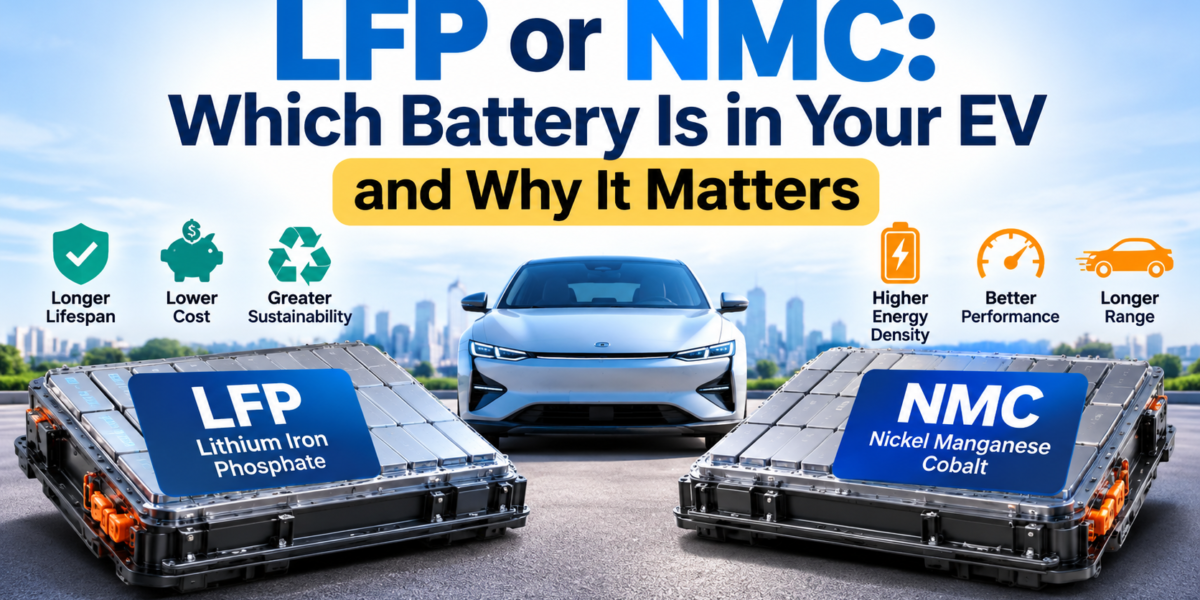
Almost every EV has a battery chemistry printed somewhere in its documentation, but most owners never look for it. That is a missed opportunity, because the chemistry shapes how the battery behaves in cold weather, how much it costs to make, how long it lasts, and how you should charge it day to day. The two chemistries most common in today’s cars are lithium iron phosphate, usually called LFP, and nickel manganese cobalt, usually called NMC.
This guide explains the main differences in plain terms, shows you how to find your car’s chemistry, and gives you a clear way to adjust your charging habits. For the detailed debate about charging to 100 percent, see our article on whether the 20 to 80 percent rule holds up. Here we focus on the chemistry itself.
What LFP and NMC are
Both are lithium-ion chemistries, but they use different materials in the cathode. LFP uses iron and phosphate, while NMC uses a mix of nickel, manganese, and cobalt. That difference changes how much energy the battery can hold for its size, how it behaves at different temperatures, and what it costs to produce.
The Charge Port’s overview of EV battery types gives a clear comparison of the main chemistries and where each one shows up. It is a good first read if you are new to the topic.
The main differences
NMC cells generally pack more energy into the same weight, which is why many long-range cars use them. LFP cells are usually cheaper and are often more durable under repeated charging, but they store less energy for the same size. Those trade-offs explain why automakers choose different chemistries for different models.
Cold behavior differs too. Both chemistries lose some capacity and power in low temperatures, but the amount and the recovery pattern vary. The Recharged comparison of LFP and NMC batteries in electric cars explains how these differences show up in real use, and it is worth reading with your car’s climate in mind.
Step 1: Find out which chemistry your car uses
Start with the owner manual or the specification sheet. Many manufacturers list the battery chemistry directly, sometimes as “LFP” or “lithium iron phosphate.” If you cannot find it, check the manufacturer’s website for the battery details, or ask the dealer to confirm in writing. Do not guess based on the model name, because two versions of the same car can use different packs.
Step 2: Match your charging habits to the chemistry
Charging advice depends on chemistry. Many manufacturers recommend charging LFP packs to full more often, sometimes so the battery management system can recalibrate its estimate of capacity. Many also suggest that NMC owners avoid keeping the battery at full charge for long periods, though the guidance varies by model.
Follow your manufacturer’s guidance first. The general idea is to charge to the level you need, and to use the car’s charge-limit setting if it has one. If you are unsure, the owner manual is more reliable than a forum rule of thumb.
| Chemistry | Common strengths | Common trade-offs |
| LFP | Lower cost, long cycle life, often charges to full well | Lower energy density, more sensitive to cold in some designs |
| NMC | Higher energy density, common in long-range models | Higher cost, charging habits matter more |
Step 3: Learn how the chemistry affects cold weather
Cold weather affects both chemistries, but the effect on range and charging depends on the design and the battery management system. If you live in a cold climate, check how your car handles preconditioning and whether the battery heats itself before fast charging. A car with a good heating system will recover range faster on a cold morning.
For a broader look at cold-weather range loss in real driving, our article on how much range an EV loses in cold weather covers the trends. The chemistry is one factor among several, including the heat system and the driving pattern.
Step 4: Think about replacement and resale
Chemistry can also affect what happens later. LFP packs are often cheaper to make, which may affect replacement cost over time, though prices depend on the car and the market. NMC packs may carry a higher replacement cost. Check the warranty for your specific chemistry, and ask whether the warranty terms change with the pack type.
When you buy a used EV, the chemistry matters too. A buyer who wants to fast charge daily may prefer one chemistry over another, and a seller who knows the pack type can give a clearer answer about its history.
Putting it together
If you have an LFP car, follow the manufacturer’s advice on full charges and cold-weather preconditioning. If you have an NMC car, keep the battery out of long periods at full charge if your manual recommends it, and charge to the level you need for each day. In both cases, check the owner manual, and do not assume that a rule for one chemistry applies to the other.
Research note from the EVs-Future team: Battery chemistry guidance differs by manufacturer and model, so always confirm your car’s recommendations in the owner manual. The sources above describe general trade-offs. Check each for its date and the test conditions it used before quoting specific figures.